
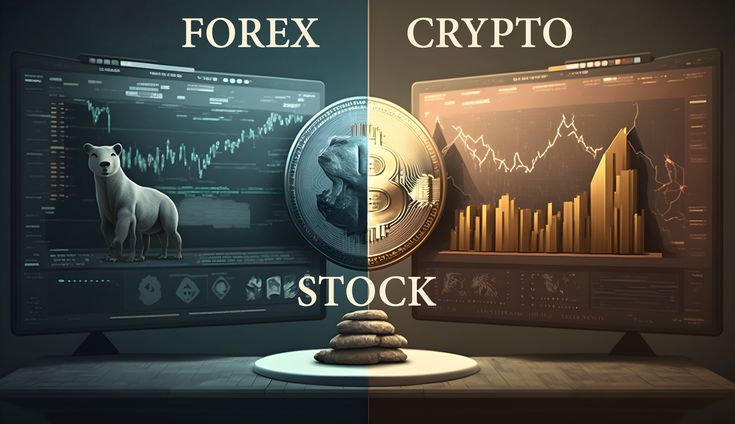
Anyone researching how to start trading or investing eventually runs into the same fork in the road: forex, stocks, or crypto? All three markets promise the chance to grow your money, all three are accessible from a smartphone in minutes, and all three have passionate communities insisting theirs is the best place to start. That makes the decision genuinely confusing for a beginner with no frame of reference.
The honest answer is that there’s no single “best” market for everyone — but there is a best market for you, depending on your goals, risk tolerance, available time, and starting capital. This guide breaks down how forex, stocks, and crypto actually compare across the factors that matter most, so you can make that decision with a clear head rather than a coin flip.
The Quick Answer
If you want the short version before diving into the details: stocks are generally considered the most beginner-friendly starting point for long-term wealth building, thanks to lower volatility, regulatory protection, and decades of historical data supporting long-term growth. Forex offers more flexibility and round-the-clock access but comes with steep leverage risk and a notoriously difficult learning curve. Crypto offers the most explosive upside and round-the-clock excitement, but also the most extreme volatility and the least regulatory protection.
That said, “best” depends heavily on what you’re optimizing for. Let’s break down exactly why.
What Each Market Actually Is
Before comparing them, it’s worth being precise about what you’re actually trading in each case.
Stocks represent partial ownership in a publicly traded company. When you buy a share of a company, you own a small slice of that business, including (in many cases) a claim on its future profits through dividends, and a vote on certain corporate matters. Stock prices generally reflect a company’s earnings, growth prospects, and the broader health of the economy.
Forex (foreign exchange) is the trading of currency pairs — buying one currency while simultaneously selling another, betting on how their relative value will shift. You’re not buying a piece of anything; you’re speculating on macroeconomic forces like interest rates, inflation, and trade flows.
Crypto involves buying and selling digital assets like Bitcoin, Ethereum, or thousands of smaller alternative coins, which exist on decentralized blockchain networks. Unlike stocks, most cryptocurrencies don’t represent ownership in a company or claim to future profits — their value is driven largely by adoption, scarcity, sentiment, and speculation.
Market Size and Liquidity
Liquidity refers to how easily you can buy or sell an asset without significantly affecting its price — and it has real consequences for traders, particularly around cost and execution speed.
The forex market is, by a wide margin, the largest financial market in the world, with daily trading volume exceeding $7 trillion. This enormous liquidity means extremely tight spreads on major currency pairs and almost instant trade execution, even with large position sizes.
The stock market is also highly liquid, particularly for large, well-known companies (often called “blue chips”), though liquidity varies significantly by company size. A mega-cap stock will trade with minimal friction; a small, thinly traded company might have wider spreads and more price slippage.
Crypto liquidity has grown dramatically over the past several years, especially for major coins like Bitcoin and Ethereum, but it still lags behind forex and major stocks. Liquidity also varies enormously across the thousands of smaller, lesser-known coins — some of which can be difficult to sell quickly without moving the price substantially.
Volatility and Risk
This is one of the starkest differences between the three markets, and arguably the single most important factor for a beginner to understand.
Crypto is, generally speaking, the most volatile of the three. Double-digit percentage swings in a single day are common, even for major coins, and smaller “altcoins” can move 30%, 50%, or more in extreme cases. This volatility creates the potential for rapid gains, but equally the potential for rapid, painful losses.
Forex sits in the middle, though leverage complicates the comparison. On their own, day-to-day moves in major currency pairs are usually modest — often less than 1% in a single session. But because forex brokers typically offer high leverage (sometimes 50:1 or higher), even small price movements can translate into outsized gains or losses relative to your actual deposited capital. In practice, this means forex can feel as risky as crypto, or riskier, depending on how much leverage a trader chooses to use.
Stocks are generally the least volatile of the three on a day-to-day basis, particularly large, established companies. Sharp single-day moves do happen, especially around earnings reports or major news, but the broader stock market has historically been less prone to the kind of extreme, rapid swings common in crypto.
| Factor | Forex | Stocks | Crypto |
|---|---|---|---|
| Typical daily volatility | Low-moderate (amplified by leverage) | Low-moderate | High to extreme |
| Common leverage offered | Very high (often 30:1–500:1) | Low to moderate (2:1 typical for retail) | Varies widely; can be very high on some platforms |
| Historical track record | Decades of data | Over a century of data | Just over a decade of data |
Trading Hours and Accessibility
Forex trades 24 hours a day, five days a week, following major financial centers around the world — Sydney, Tokyo, London, and New York. This makes it appealing to people who want flexibility around a day job, since there’s almost always an active session to trade during.
Stock markets operate on fixed exchange hours, typically weekdays during business hours in their respective countries (for example, 9:30 AM to 4:00 PM Eastern Time for U.S. exchanges), though many brokers now offer limited pre-market and after-hours trading.
Crypto markets never close. They trade 24 hours a day, seven days a week, including weekends and holidays, since there’s no centralized exchange or governing body dictating trading hours. This is appealing to some, but it also means price-moving news can break at 3 a.m. with no warning and no circuit breaker to pause trading.
Capital Requirements
One of the biggest practical questions for beginners is how much money you actually need to get started.
Forex often advertises very low minimum deposits, sometimes as little as $10–$100, thanks to the widespread availability of micro and nano lots combined with leverage. This makes it attractive to beginners with limited starting capital, though it also means it’s easy to take on outsized risk relative to a small account.
Stocks have become increasingly accessible thanks to fractional share investing, which allows you to buy a small slice of an expensive stock (like a fraction of a share of a company trading at hundreds of dollars) for as little as a few dollars. Many brokers now also offer commission-free trading, removing what used to be a meaningful barrier to entry.
Crypto generally has very low barriers to entry as well, with many exchanges allowing purchases of a few dollars’ worth of a coin. The flexibility to buy fractional amounts of expensive assets like Bitcoin makes it accessible regardless of account size.
In short, all three markets have become quite accessible from a pure capital-requirement standpoint — the differences here are smaller than they used to be.
Regulation and Investor Protection
This is an area where the three markets diverge sharply, and it’s one beginners often underweight in their decision-making.
Stocks are traded on regulated exchanges and overseen by established financial regulators in most countries, with rules around disclosure, insider trading, and broker conduct that have developed over many decades. Brokerage accounts in many jurisdictions also benefit from investor protection schemes that offer some compensation if a brokerage firm fails (though this does not protect against market losses).
Forex regulation varies considerably depending on the broker and the country. Reputable forex brokers are regulated by recognized financial authorities, but the market also has a long history of unregulated or offshore brokers operating with far less oversight, sometimes engaging in practices that disadvantage retail clients. Choosing a properly regulated broker is critical and requires real diligence.
Crypto remains the least regulated of the three in most jurisdictions, though this is gradually changing as governments introduce clearer frameworks. The relative lack of oversight has historically made the space more vulnerable to fraud, exchange failures, and market manipulation, and there is generally far less recourse for retail investors if something goes wrong compared to traditional stock brokerages.
Learning Curve
Stocks tend to have the gentlest learning curve for an absolute beginner. The core concept — buying ownership in a company you believe will grow — is intuitive, and there’s a vast ecosystem of educational resources, company reports, and analyst coverage to lean on. Long-term, “buy and hold” investing in diversified index funds is also widely accessible and doesn’t require mastering technical analysis or chart reading at all.
Forex has a notoriously steep learning curve, not necessarily because the core concept (currency pairs moving in value) is hard to understand, but because trading it well requires grasping leverage, margin, macroeconomic analysis, and technical chart reading — and because the temptation to use high leverage often leads beginners into losses before they’ve had time to learn properly.
Crypto sits somewhere in between. The basic concept of buying and holding a coin is simple enough for anyone to grasp quickly, but understanding the broader ecosystem — blockchain technology, tokenomics, the differences between thousands of competing projects, and the unique risks of self-custody and exchange security — adds real complexity for those who want to go beyond simply buying and holding a major coin.
Long-Term Track Record
It’s worth being clear-eyed about how much historical data actually exists behind each market.
Stocks have over a century of data showing that, over long time horizons, broad stock market indexes have historically trended upward, even accounting for significant downturns along the way. This long track record is part of why diversified, long-term stock investing is so frequently recommended as a foundation for building wealth.
Forex has existed in its modern, freely floating form since the early 1970s, and currency markets have a long history tied to global trade and monetary policy. However, currencies don’t have the same kind of long-term “growth” story that stocks do — a currency pair simply oscillates in relative value over time, rather than compounding in value the way company earnings can.
Crypto is, by comparison, a very young asset class, with Bitcoin only created in 2009 and the vast majority of other cryptocurrencies existing for far less time than that. While crypto has produced extraordinary returns for early adopters of certain coins, it lacks anywhere near the depth of historical data that stocks or even forex can offer, making long-term predictions considerably more speculative.
Which Market Fits Which Type of Beginner?
Rather than declaring one market universally “best,” it’s more useful to match the market to your personal situation and goals.
If your priority is long-term wealth building with lower stress
Stocks — particularly diversified index funds — are generally the most appropriate starting point. The historical data, regulatory protections, and lower day-to-day volatility make stocks a more forgiving environment for someone who wants to grow wealth steadily over years or decades, without needing to watch charts constantly.
If you want flexible hours and don’t mind a steep learning curve
Forex may appeal to those who want to trade actively around a job or other commitments, given its 24-hour, five-day-a-week schedule. However, this path demands serious discipline around leverage and risk management, and beginners should expect to spend significant time learning and practicing on a demo account before trading real money.
If you’re drawn to higher risk and faster-moving markets
Crypto suits those genuinely comfortable with high volatility and who want exposure to an emerging asset class, but it should generally represent a smaller portion of a beginner’s overall portfolio given the risk involved, rather than a primary starting point for someone with no trading experience at all.
If you’re not sure yet
Many experienced traders and investors actually start with stocks — particularly simple, diversified, long-term investing — to build foundational comfort with how markets move, manage risk, and behave during downturns, before exploring more volatile or leveraged markets like forex or crypto with money they’re fully prepared to lose.
Common Beginner Mistakes Across All Three Markets
Regardless of which market you choose, several mistakes tend to trip up beginners universally:
- Starting with real money before practicing. Nearly every broker and exchange offers some form of demo account, paper trading, or small-scale testing. Skipping this step is one of the most common ways beginners lose money quickly.
- Using excessive leverage, particularly in forex, where high leverage is heavily marketed but poorly understood by newcomers.
- Chasing recent performance, whether that’s jumping into a stock after a huge rally, a currency pair after a big move, or a crypto coin after it’s already gone viral — often right before momentum reverses.
- Underestimating fees and costs, including spreads, overnight financing charges in forex, trading commissions, and withdrawal or network fees in crypto.
- Ignoring risk management entirely, such as failing to diversify, risking too much capital on a single trade, or not having any predetermined exit plan.
- Letting emotion drive decisions, particularly fear during downturns and greed during rallies — a challenge that exists in every single one of these markets, regardless of how different they are technically.
Can You Trade All Three?
Absolutely — and many experienced traders and investors eventually do diversify across multiple markets. There’s nothing that requires you to pick just one permanently. A common and sensible approach for beginners is to:
- Start with a foundational understanding of stocks and long-term investing principles, since the lessons learned here (risk management, patience, avoiding emotional decisions) transfer directly to other markets.
- Gradually explore forex or crypto with a small, clearly defined portion of capital you’re fully prepared to lose, once you’ve built some baseline experience and discipline.
- Continue expanding your knowledge across markets over time, rather than feeling pressure to master everything immediately.
Final Thoughts
There’s no universally “correct” answer to whether forex, stocks, or crypto is best for beginners — each market rewards a different temperament, timeline, and risk appetite. Stocks generally offer the gentlest entry point and the strongest long-term track record, making them a sensible foundation for most newcomers. Forex offers flexibility and round-the-clock access but demands serious respect for leverage and risk. Crypto offers explosive potential alongside the highest volatility and the least regulatory protection of the three.
The right starting point isn’t necessarily the one with the highest potential returns — it’s the one that matches your risk tolerance, your available time to learn, and your patience for a learning curve. Whichever market you choose, the same underlying principles apply: start small, practice with a demo or paper account first, never risk money you can’t afford to lose, and prioritize understanding the mechanics of the market over chasing fast profits. Those habits, more than any single market choice, are what actually separate beginners who succeed from those who don’t.