
The Notification That Changes Everything
It’s a Tuesday morning in 2026. You open your brokerage app to check your Tesla position, and something looks different. Next to your regular shares, there’s a new tab labeled “Tokenized Assets.” Your friend sent you a link last night about buying a fraction of a Manhattan apartment through some blockchain thing. Your cousin keeps talking about “yield-bearing tokenized T-bills.” And somewhere between your morning coffee and your first meeting, you realize a quiet revolution has happened while you weren’t paying attention.
Tokenized stocks. Real World Assets. RWA. These are the most searched terms in finance right now, and for good reason. In 2026, the wall between traditional finance and blockchain has finally cracked. BlackRock is tokenizing money market funds. Stock exchanges are piloting 24/7 tokenized equity trading. Your neighbor is talking about owning 0.003% of a commercial building in Miami through an app on his phone.
But here’s the problem: almost nobody explains what’s actually happening in plain English. Crypto natives speak in jargon — smart contracts, oracles, liquidity pools — and assume you already get it. Traditional finance folks dismiss it as hype or warn you it’s all a scam. The truth is somewhere in the messy middle, and finding it requires cutting through two different languages.
So let’s do that. No blockchain theology. No Wall Street condescension. Just an honest look at what tokenized stocks and real world assets actually are, why they’re exploding in 2026, and what you need to know before your curiosity turns into a click on the “buy” button.
The Simple Analogy: From Paper to Pixels to Tokens
To understand tokenization, you have to understand what came before.
For most of history, owning something valuable meant holding a physical object or a piece of paper. You owned a stock? You got a paper certificate. You owned a house? You got a deed. You owned gold? You physically stored it. These paper records were the bridge between you and your asset.
Then came the digital revolution. Your stocks moved from paper certificates to electronic entries in a central database run by your broker. Your house deed was scanned into a county database. Your gold became a number on a screen. But here’s the thing: these digital records were still controlled by middlemen. Your broker. The county clerk. The bank. You didn’t really hold your assets. You held a promise from an institution that the asset was yours.
Tokenization is the next step. It takes those assets — stocks, bonds, real estate, commodities, even fine art — and represents them as digital tokens on a blockchain. Instead of your broker keeping a record of your 100 Apple shares in a private database, those shares exist as tokens on a distributed ledger. Instead of a deed sitting in a courthouse, a real estate property is divided into thousands of tokens, each representing fractional ownership.
Think of it like this: a token is a digital container. You can put almost anything inside that container — a share of stock, a slice of a building, a claim on a barrel of oil. Once it’s inside, the container can move anywhere the blockchain reaches, instantly, 24 hours a day, to anyone with an internet connection.
That’s the pitch, anyway. The reality is more complicated. But the analogy holds: tokenization is about turning illiquid, slow, gatekept assets into programmable, movable, divisible digital objects.
Tokenized Stocks: When Your Shares Become Crypto
Let’s start with the concept that’s confusing the most people in 2026: tokenized stocks.
You already know what a stock is. You buy a share of Apple, you own a tiny piece of Apple Inc. You get dividends. You get voting rights (maybe). You can sell it during market hours through your broker.
A tokenized stock is the same economic exposure, but the plumbing is different. Instead of your ownership being recorded in a database at Charles Schwab or Fidelity, it’s recorded on a blockchain. The token in your digital wallet represents the same legal claim on Apple’s cash flows and assets as a traditional share.
There are two main ways this happens right now:
1. Wrapped securities (backed 1:1 by real shares) A regulated institution buys real Apple shares and holds them in custody. They then issue tokens on a blockchain, each token backed by one real share. When you buy the token, you’re not buying some crypto fantasy — you’re buying a synthetic representation of the actual stock, backed by the real thing. The institution handles dividends, corporate actions, and the legal relationship with Apple. You get the price exposure and the ability to trade 24/7.
2. Native tokenized equity Some newer companies — especially in the crypto and fintech space — are issuing their shares directly on blockchain from day one. No paper. No legacy exchange. The company’s cap table lives on a distributed ledger. When you buy these tokens, you’re buying the actual equity instrument, not a wrapper around something else.
Why This Matters in 2026
The reason tokenized stocks are trending isn’t because crypto bros finally convinced Wall Street to “decentralize everything.” It’s because the traditional system has real, expensive inefficiencies that tokenization actually solves.
Settlement speed. When you buy a stock today, it takes T+1 (or in some cases still T+2) to settle. That means your money is in limbo for a day or two. Tokenized stocks settle in minutes, or even seconds, because the blockchain updates ownership instantly.
24/7 trading. The New York Stock Exchange closes at 4 PM. Tokenized stocks don’t sleep. If Elon Musk tweets at midnight on a Saturday, you can trade the tokenized Tesla exposure immediately instead of waiting for Monday morning and watching the gap down.
Fractional ownership made seamless. You can already buy fractional shares through apps like Robinhood. But tokenization takes this further. You can own $5 worth of a $3,000 stock and instantly lend it, use it as collateral, or move it to a different platform without asking permission.
Global access. A trader in Nigeria or Indonesia can buy tokenized exposure to the S&P 500 without needing a U.S. brokerage account, a Social Security number, or a minimum balance. The blockchain doesn’t care where you live, as long as you follow the platform’s compliance rules.
But — and this is crucial — tokenized stocks are not decentralized. This is the biggest misconception. When you buy a tokenized Apple share, you are still trusting a custodian. You are still subject to securities laws. You are still in the regulated world. The blockchain is just a better database, not a revolution in ownership structure. If the custodian holding the real Apple shares goes bankrupt or gets hacked, your token might be worthless. The “crypto” wrapper doesn’t eliminate counterparty risk. It just moves it around.
Real World Assets (RWA): Beyond Stocks
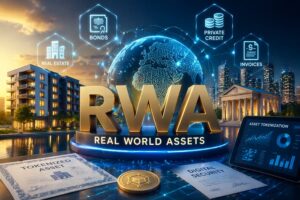
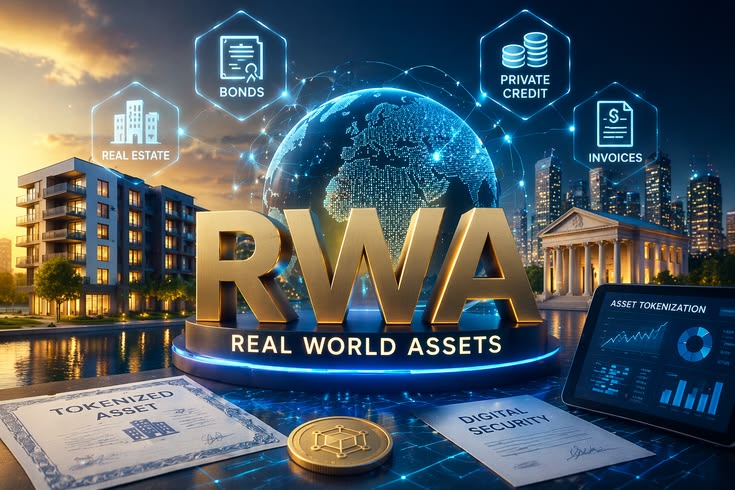
If tokenized stocks are about putting traditional equities on a blockchain, Real World Assets (RWA) is the broader category that asks: what else can we tokenize?
The answer, in 2026, is: almost everything.
Real estate. Instead of buying an entire apartment building for $5 million, the building is tokenized into 5 million tokens at $1 each. You buy 1,000 tokens. You now own 0.02% of the building. You collect rental income proportional to your holdings, distributed automatically to your wallet. When you want to sell, you don’t need a realtor, a title company, and three months of paperwork. You list your tokens on a secondary market and sell them in minutes.
Treasury bills and bonds. BlackRock’s BUIDL fund and similar products have made tokenized T-bills a massive market in 2026. You buy a token representing a share of a Treasury bill. You earn yield. You can trade the token anytime. You can use it as collateral in decentralized finance (DeFi) protocols to borrow against it. It’s a government bond that behaves like a stablecoin.
Commodities. Gold has been tokenized for years, but now you’re seeing oil, carbon credits, agricultural futures, and even water rights represented as tokens. A shipping company might tokenize a cargo of coffee beans, allowing traders to buy and sell exposure to the shipment while it’s still at sea.
Private credit and invoices. A small business in Brazil tokenizes its unpaid invoices. Investors around the world buy the tokens, earning yield when the invoices are paid. The business gets instant liquidity instead of waiting 90 days. This is happening at scale in 2026.
Fine art and collectibles. A Basquiat painting gets tokenized. You buy 50 tokens. You don’t get to hang it on your wall, but you get exposure to its price appreciation and a share of any rental income if it’s exhibited in a museum. When the painting sells for $50 million, your tokens appreciate.
The Psychology of RWA: Why People Are Searching
Here’s why RWA is one of the hottest search terms of 2026: it promises the impossible combination of crypto convenience and traditional safety.
For years, crypto was a speculative casino. Bitcoin, Ethereum, meme coins — these were volatile, unregulated, and terrifying to normal people. Meanwhile, traditional assets were safe but boring, slow, and inaccessible. RWA bridges that gap. It says: “You can have the yield of a Treasury bond, the returns of real estate, and the speed of a crypto token.”
This is incredibly seductive. It triggers two powerful psychological desires at once:
- The desire for safety. RWA assets are backed by real things — buildings, government debt, actual companies. That feels safer than a dog-themed cryptocurrency.
- The desire for speed and control. You can trade them instantly, move them globally, and program them to do things automatically. That feels futuristic and empowering.
But this seduction is also where the danger lives. When something feels both safe and cutting-edge, people stop asking hard questions. They assume the “real world” backing eliminates risk. It doesn’t. It just changes the shape of the risk.
How It Actually Works (Without the Jargon)
Let’s pull back the curtain on the mechanics, because this is where most explanations fall apart.
Step 1: The Asset Exists in the Real World There is an actual building, an actual Treasury bill, an actual share of stock. This is not imaginary. A legal entity — usually a Special Purpose Vehicle (SPV) or a trust — owns the asset on behalf of token holders.
Step 2: Legal Structure Lawyers create a framework that connects the token to the asset. This might mean the token is legally classified as a security. It might mean token holders have direct ownership rights, or it might mean they have a contractual claim on the cash flows. This legal wrapper is everything. Without it, you’re just buying a crypto token with no enforceable rights.
Step 3: Tokenization A technology provider creates digital tokens on a blockchain — usually Ethereum, but increasingly on faster, cheaper chains like Solana, Avalanche, or private permissioned blockchains. Each token is programmed with rules: how dividends are paid, how voting works, what happens if the asset is sold.
Step 4: Custody and Oracles Someone has to hold the real asset. A bank or regulated custodian keeps the Treasury bills. A property manager maintains the building. “Oracles” — trusted data feeds — update the blockchain with real-world information: the current price of the asset, rental income received, interest payments made.
Step 5: Trading and Settlement Tokens trade on digital exchanges — some centralized, some decentralized. When you buy a token, ownership transfers instantly on the blockchain. No T+2 settlement. No clearinghouse. Just a cryptographic update to a ledger.
Step 6: Cash Flows When the asset generates income — rent, dividends, interest — the smart contract automatically distributes it to token holders. You wake up and find stablecoins in your wallet. No paperwork. No waiting for a check in the mail.
This sounds seamless. And when it works, it is. But notice how many trusted parties are still involved. Custodians. Lawyers. Oracles. Property managers. Regulators. The blockchain removes some middlemen, but not all of them. The “trustless” ideal of crypto purists doesn’t fully apply to RWA. You’re still trusting humans to tell the truth about the real world.
The Brutal Truth: What Can Go Wrong
If you’re searching for RWA opportunities in 2026, you need to understand the risks that the marketing glosses over.
Smart contract risk. The code that runs the token might have a bug. Hackers might exploit it. In 2022, we saw bridges and protocols drained of hundreds of millions because of a few lines of bad code. Tokenized assets are only as secure as the code governing them.
Custodian risk. If the institution holding the real Apple shares or Treasury bills goes insolvent, what happens to your token? In a well-structured deal, the assets are bankruptcy-remote — meaning they’re legally separate from the custodian’s own finances. But legal structures can be messy, especially across jurisdictions.
Oracle risk. If the data feed that tells the blockchain “the building is worth $5 million” gets corrupted or manipulated, the token’s price can diverge from reality. This is a largely unsolved problem in RWA. The blockchain is only as good as the data fed into it.
Regulatory risk. Tokenized securities exist in a rapidly evolving legal landscape. What’s legal in Singapore might be illegal in New York. A platform operating today might be shut down by regulators tomorrow. If you’re holding tokens on a platform that gets sanctioned, your assets could be frozen.
Liquidity risk. Just because something is tokenized doesn’t mean there’s a market for it. You might own 1,000 tokens in a tokenized apartment building, but if no one wants to buy them, you can’t exit. The token is liquid in theory but illiquid in practice.
The “real world” doesn’t move at blockchain speed. If a tenant stops paying rent on your tokenized building, the smart contract can’t evict them. If a company issuing tokenized stock goes bankrupt, the blockchain can’t reorganize the company. Real world problems still require real world solutions, and those solutions are slow, expensive, and human.
The Psychology of Trust in a Tokenized World
There’s a fascinating psychological shift happening in 2026 that most people haven’t named yet.
For decades, trust in finance was institutional. You trusted Fidelity because it was big, regulated, and had been around since 1946. You trusted the government because, well, it was the government. Trust was centralized.
Tokenization promises to decentralize trust. Instead of trusting one bank, you trust a network of computers, a transparent ledger, and a set of rules encoded in software. This appeals to a deep human desire for fairness and transparency. The blockchain doesn’t lie. It doesn’t have a CEO who can embezzle funds. It just executes code.
But here’s the psychological trap: blockchain trust and real world trust are not the same thing.
The blockchain can tell you exactly who owns a token. It cannot tell you whether the building the token represents actually exists. It cannot tell you whether the custodian is honest. It cannot tell you whether the legal structure will hold up in court.
In other words, tokenization solves the problem of digital trust — who owns what, and when did they get it — but it does not solve the problem of physical trust — is the underlying asset real, maintained, and legally sound?
The traders and investors who get hurt in the RWA boom will be the ones who confuse these two types of trust. They’ll see the blockchain transparency and assume the whole stack is transparent. They’ll see the token trading smoothly and assume the real asset is equally sound.
The smart money does the opposite. They ignore the blockchain hype and dig into the legal docs, the custodian’s balance sheet, the property manager’s track record, and the jurisdiction’s regulatory stance. The blockchain is just the wrapper. The asset inside is what matters.
Tokenized Stocks vs. Crypto: The Identity Crisis
One of the most searched questions in 2026 is some variation of: “If I buy a tokenized stock, am I investing in crypto?”
This question reveals a fundamental confusion that the industry has failed to clear up.
The answer is: it depends on what you mean by “crypto.”
If by crypto you mean “a digital asset that uses blockchain technology,” then yes, tokenized stocks are crypto. They live on a blockchain. They use wallets. They settle cryptographically.
If by crypto you mean “a speculative, unregulated, decentralized asset with no underlying cash flows,” then no, tokenized stocks are not crypto. They are securities. They are regulated. They have underlying cash flows, voting rights, and legal protections. They just happen to use a different database.
This identity crisis matters because it determines how you should think about risk. If you treat a tokenized Treasury bill like a meme coin, you’ll panic-sell during volatility that a bond holder should ignore. If you treat a tokenized real estate token like a blue-chip stock, you’ll be shocked when it takes months to find a buyer.
The mental model that works is this: judge the asset by what’s inside the token, not by the technology carrying it. A tokenized T-bill is a bond. A tokenized apartment is real estate. A tokenized meme is a meme. The blockchain is the envelope. The letter inside is what determines the risk.
The 2026 Landscape: Who’s Actually Doing This?
To ground this in reality, here’s what the RWA and tokenized stock market looks like as of 2026:
Institutional giants. BlackRock, Franklin Templeton, and Hamilton Lane have launched tokenized money market funds and private credit products. These aren’t experiments anymore — they’re billion-dollar products with institutional clients.
Stock exchanges. The NYSE, NASDAQ, and several international exchanges have piloted or launched tokenized equity trading platforms. Some operate parallel to traditional markets. Others are building entirely blockchain-native exchanges.
Real estate platforms. Companies like RealT, Lofty, and institutional players have tokenized thousands of properties. Retail investors can buy $50 worth of a rental property and earn daily or weekly rent distributions.
DeFi integrations. Tokenized T-bills are being used as collateral in lending protocols. You can deposit your tokenized government bonds and borrow against them instantly, earning yield on the collateral while using the borrowed funds to trade. This is creating a parallel financial system that interoperates with traditional assets.
Regulatory clarity (sort of). The SEC, EU, and several Asian regulators have issued frameworks for tokenized securities. It’s not perfectly clear everywhere, but it’s clearer than it was in 2022. The Wild West phase is ending. The compliance phase is beginning.
How to Think About RWA as an Investor or Trader
If you’re one of the millions searching for RWA and tokenized stocks in 2026, here’s a practical framework for evaluating opportunities without getting swept up in the hype.
1. Ask what the token actually represents. Is it a direct ownership stake? A revenue share? A debt instrument? A derivative? Read the legal documentation. If there is no legal documentation, run.
2. Who holds the real asset? Is there a regulated custodian? Is the asset bankruptcy-remote? What happens if the platform goes under? If you can’t answer these questions, you don’t understand the risk.
3. Where does the yield come from? If a tokenized real estate product promises 12% yield, is that because the property is genuinely profitable, or because new investor money is paying old investors? Real yields in 2026 for real estate and credit are generally in the 4-8% range. Anything significantly higher demands extra scrutiny.
4. Can you actually exit? Check the secondary market volume. A token is only as liquid as the market willing to buy it. If daily volume is $2,000 and you own $50,000 worth of tokens, you’re trapped.
5. What chain is it on? Ethereum is battle-tested but expensive. Solana is fast but has had outages. Private blockchains are efficient but centralized. The choice of blockchain affects security, cost, and censorship resistance. It’s not just a technical detail.
6. What are the tax implications? Tokenized assets might trigger different tax events than traditional assets. Automatic yield distributions to your wallet might be taxable events the moment they arrive, even if you don’t sell. Talk to an accountant who understands crypto.
The Future: Where This Is Going
Tokenization in 2026 is not a fringe experiment. It’s an infrastructure upgrade. In the same way that the internet digitized information and email digitized mail, blockchain is digitizing asset ownership.
Within a few years, it’s likely that most new securities will be issued natively on blockchain. Your brokerage account will be indistinguishable from a crypto wallet. You’ll earn yield on your checking account through tokenized money market funds. You’ll buy a fraction of a sports team, a song royalty, or a carbon credit as easily as you buy a stock today.
But the transition will be messy. There will be scams dressed up as RWA. There will be regulatory crackdowns. There will be platforms that promise the world and deliver bankruptcy. The technology is sound. The implementation is still human.
The traders and investors who thrive in this new world won’t be the ones who understand blockchain the best. They’ll be the ones who remember that a token is just a container, and the asset inside is what matters. They’ll bring the same skepticism to a tokenized building that they’d bring to buying the building in person. They’ll read the fine print. They’ll verify the custodian. They’ll treat the blockchain as a tool, not a religion.
Final Thoughts
Tokenized stocks and Real World Assets represent one of the most important financial trends of this decade. They have the potential to make markets faster, fairer, and more accessible. They can unlock liquidity in assets that have been frozen for centuries. They can give a farmer in Kenya the same access to U.S. Treasury yields as a hedge fund in Connecticut.
But they are not magic. They do not eliminate risk. They do not replace due diligence. The blockchain is a better ledger, not a better brain. The investors who get hurt will be the ones who trusted the technology more than they trusted their own judgment.
If you’re searching for RWA in 2026, you’re early. You’re watching the plumbing of global finance get replaced. That’s exciting. But excitement is the enemy of good decisions. Do your homework. Read the legal docs. Verify the custodians. And never forget that in a tokenized world, the word “trustless” only applies to the code — not to the humans who wrote it.